
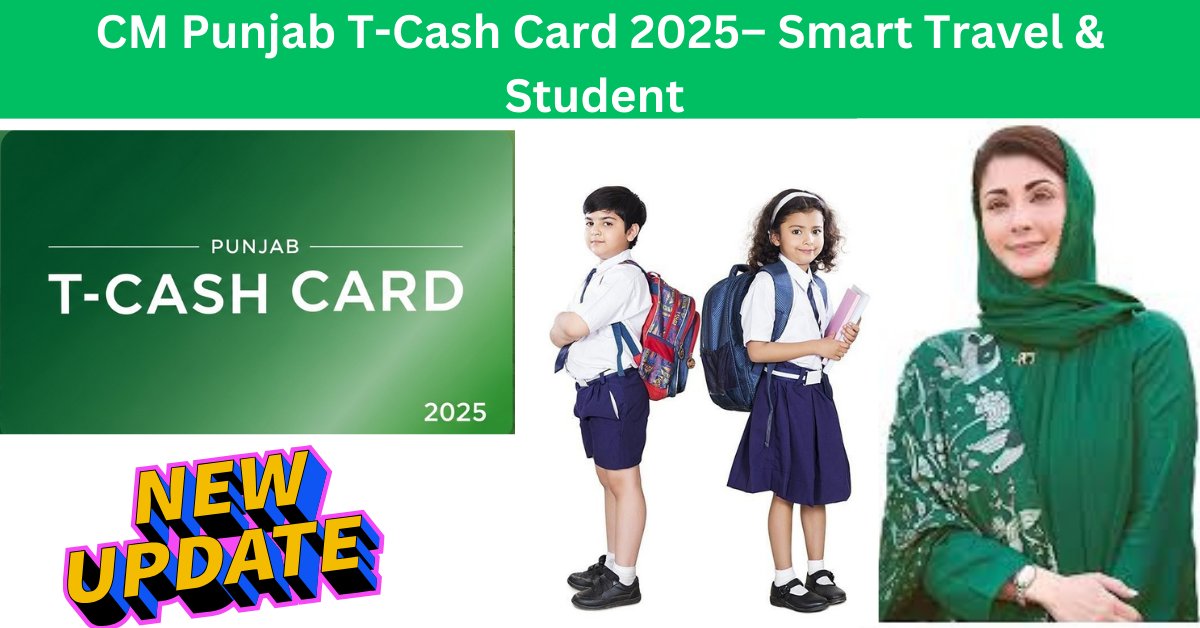
Punjab Chief Minister’s T-Cash Card 2025: Smart Travel and Student Assistance Program
Envision a single smart card that allows you to access public transportation, pay for a quick snack, and manage your monthly student support—all without using cash.
That’s the expectation surrounding the CM Punjab T-Cash Card 2025– Smart Travel & Student Support Initiative.
If you’re a student, commuter, or parent in Punjab, this could transform your daily routine.
What is the CM Punjab T-Cash Card 2025– Smart Travel & Student Support Initiative?
Essentially, it’s a reloadable smart card that simplifies travel and provides targeted financial assistance to students.
Think “tap-to-ride” combined with “tap-to-pay,” all linked to eligibility criteria.
Since the 2025 programs may evolve before their launch, consider the features below as a preliminary overview of what’s likely, based on public announcements and the functionality of similar cards globally.
Summary at a glance
Here’s a concise snapshot you can skim now and refer back to later.
| Aspect | Details |
| Official name | CM Punjab T-Cash Card 2025– Smart Travel & Student Support Initiative |
| Purpose | Cashless public transport + student support top-ups (stipends, fare subsidies) |
| Target users | Students (priority), daily commuters, youth trainees; potential inclusion for low-income groups |
| Where it could work | City buses, BRT/Metrobus, metro/rail corridors; retail acceptance via NFC/QR (as enabled) |
| Card type | Contactless smart card (likely NFC), reloadable, PIN/app-enabled wallet |
| Benefits | Discounted fares, seamless transfers, monthly student top-ups, digital receipts |
| Rollout approach | Phased city-first pilot (e.g., Lahore), with expansion following performance review |
| Cost to user | Small card issuance fee; subsidized fares; no-fee student top-ups (policy-dependent) |
| Top-up channels | Mobile banking apps, partner agents, kiosks at stations, online portals |
| Oversight | Provincial transport/education departments in collaboration with payment partners |
| Status | Awaiting final specification/notification; details may vary prior to launch |
Why this matters right now
Waiting in cash lines is frustrating.
Unreliable change wastes both time and money.
For students on limited budgets, every rupee is vital.
A smart, unified card can help minimize fare leakage, reduce boarding times, and ensure financial aid is delivered promptly and transparently.
Globally, cities that adopted contactless transit options (like Istanbul, London, and Singapore) report quicker boarding, reduced cash handling costs, and improved customer satisfaction.
Punjab can harness the same momentum.
How it could work (step-by-step)
- Apply: Students and commuters can register online or at kiosks using ID and a photo.
- Verify: Student status is confirmed through their institutions; other applicants verify via CNIC and supporting documents.
- Collect or receive the card: Pick it up at a partner counter or get it by mail.
- Load funds: Use a banking app, agent, ATM-like kiosk, or station booth.
- Tap and go: Tap to enter a bus or metro gate; fare is automatically deducted.
- Receive support: Eligible students will automatically receive monthly top-ups or fare subsidies.
- Track: Use an app or SMS to monitor balances, transaction history, and discounts.
Real-world context you’ll care about
- Big-city readiness: In Punjab (Pakistan), the Punjab Masstransit Authority manages Lahore’s Metrobus and the Orange Line Metro Train (approx. 27 km with 26 stations), both already equipped for automated fare collection.
- Comparable models: Delhi’s NCMC, London’s Oyster, and Istanbulkart show that integrated cards typically reduce cash handling by 60–90% and decrease boarding time per passenger—small efficiencies that culminate in smoother commutes.
- Student-first design: Directly linking support programs to the card reduces delays and eliminates intermediaries, which students appreciate and auditors endorse.
Who can apply and what you may need
If finalized as indicated, priority groups may include:
- Students in accredited colleges/universities, vocational programs, and public sector institutions.
- Youth participating in recognized training programs.
- Daily commuters who choose to opt-in for digital fares.
- Potential expansions for women, persons with disabilities, and low-income households, governed by policy.
Documents you’ll likely need:
- National ID (CNIC or student equivalent).
- Enrollment letter or student ID if applying as a student.
- Domicile or proof of residence (if regional eligibility applies).
- A recent photo and mobile number for SMS notifications.
Key features that make a difference
- One card for multiple uses: Utilize it on buses, BRT, and metro corridors as enabled.
- Subsidized travel: Students may benefit from discounted fares or a capped weekly spend.
- Stipend delivery: Monthly educational support can be directly deposited into the card wallet.
- Offline resilience: Card taps function even if a gate temporarily loses connection, syncing later.
- Loss protection: Lock your card in-app and regain your balance after a reissue.
- Transaction history: Receive digital receipts for every journey—neat, clear, and auditable.
Where you might use it
- Urban transit: City buses, feeder routes, and rapid transit corridors.
- Interchange hubs: Stations equipped with tap-in/tap-out gates.
- Retail options: Small purchases at campus canteens or partner merchants (policy-driven).
Note: Exact coverage will depend on finalized partnerships and rollout plans.
Timeline and rollout (what to expect)
- Pilot window: A city-first pilot (most likely in Lahore, given its infrastructure) is anticipated to begin in early-to-mid 2025.
- Expansion: Additional corridors and cities will follow after performance reviews, typically within 6–12 months.
- Student onboarding: Coordinated outreach at universities and colleges to facilitate adoption.
These dates will be confirmed only post-official notification.
Costs, caps, and savings
- Card fee: Expect a small one-time issuance charge; students may be eligible for waivers during special initiatives.
- Fare savings: Student discounts or caps could significantly reduce monthly commuting costs—especially for lengthy, multi-leg trips.
- Reload costs: Digital top-ups are usually free or low-cost; confirm partner policies at launch.
Security and privacy
- Standards-based tech: Contactless cards typically adhere to ISO/IEC 14443 and EMV security for payments.
- Data minimization: Journey data should be utilized for service enhancement, with privacy protections in place.
- User control: The app/SMS provides options to opt-in or out of promotional features.
A day in the life: what it feels like
- Sara, a second-year student, taps in at a metro station at 8:05 a.m. and taps out at 8:38 a.m.—no queues, no coins needed.
- At lunchtime, she uses the same card at a campus kiosk, where the app alerts her that this month’s academic top-up has just arrived.
- On Friday, she reviews her dashboard: spending is within the weekly limit, leaving her a few rupees to indulge in a snack.
That’s convenience with consideration—and a little financial flexibility.
Who’s behind the push?
The CM Punjab T-Cash Card 2025– Smart Travel & Student Support Initiative will be guided by provincial departments responsible for transport, finance, and higher education, collaborating with transit operators and payment stakeholders.
Expect strong involvement from transit authorities, campus administrations, and partnered banks to keep everything running smoothly.
Personal background: who is the CM of Punjab?
- Punjab, Pakistan: Maryam Nawaz Sharif has been the Chief Minister since 2024, marking the province’s first female CM.
Her administration has focused on modernizing public transport, enhancing mobility for women, and advancing digital public services.
Asset statements for elected officials are submitted to the Election Commission; refer to the official portal for the most updated figures.
- Punjab, India: Bhagwant Mann has served as Chief Minister since 2022.
His government emphasizes improving public services, educational upgrades, and road safety.
Asset disclosures for Indian CMs are filed during elections and can be reviewed on the Election Commission of India’s website.
If you have a specific Punjab in mind, let me know so I can customize the details to that jurisdiction’s agencies and routes.
How to get ready now (even before launch)
- Gather IDs: CNIC/student ID, enrollment letter, and a recent photo.
- Set up digital payments: Install a reliable mobile banking app to simplify top-ups.
- Look out for campus drives: Early adopters may receive fee waivers or bonus rides.
- Follow official channels: Trust only announcements from government websites and verified social media accounts.
Common pitfalls to avoid
- Buying from scalpers: Avoid purchasing a card from unofficial sellers.
- Neglecting registration: Unregistered cards may be difficult to recover if they are lost.
- Skipping updates: App updates often include crucial security patches and new offers.
Why the CM Punjab T-Cash Card 2025– Smart Travel & Student Support Initiative could be a significant advantage
It alleviates barriers, saves time, and directly delivers support to students.
This initiative can also encourage more riders to utilize safe and cleaner transport options.
Above all, it showcases a progressive Punjab that is committed to investing in youth and purposeful mobility.
FAQs: CM Punjab T-Cash Card 2025
Q1: Is the CM Punjab T-Cash Card 2025– Smart Travel & Student Support Initiative officially available?
A: Currently, details are being finalized; anticipate a phased rollout in 2025 following formal notification.
Always verify dates through official government sources.
Q2: Will it be usable on both buses and metro lines?
A: That’s the objective.
Initial pilots usually commence with specific corridors, with plans to extend across buses, BRT, and metro lines.
Q3: How will students receive stipends or fare subsidies?
A: Eligible students should receive monthly top-ups directly in the card wallet, which can be accessed via the app or SMS.
Specific amounts and regulations will be detailed at launch.
Q4: What should I do if my card is lost or stolen?
A: Notify immediately through the hotline or app.
Your balance will typically be frozen and can be transferred to a new card.
Q5: Can non-students use the card?
A: Yes, commuters can use it for cashless fares, although student-specific benefits are reserved for verified students.
Q6: Will there be any fees for reloading?
A: Digital top-ups often incur either no fees or minimal fees; partner policies will clarify exact costs.
Final takeaway
If executed properly, this initiative will not only streamline your commute—it’ll relieve stress, allocate support effectively, and make each tap feel like a step forward.
If you need a personalized checklist for your campus or city, just let me know, and I’ll create one tailored to your location and program updates.