
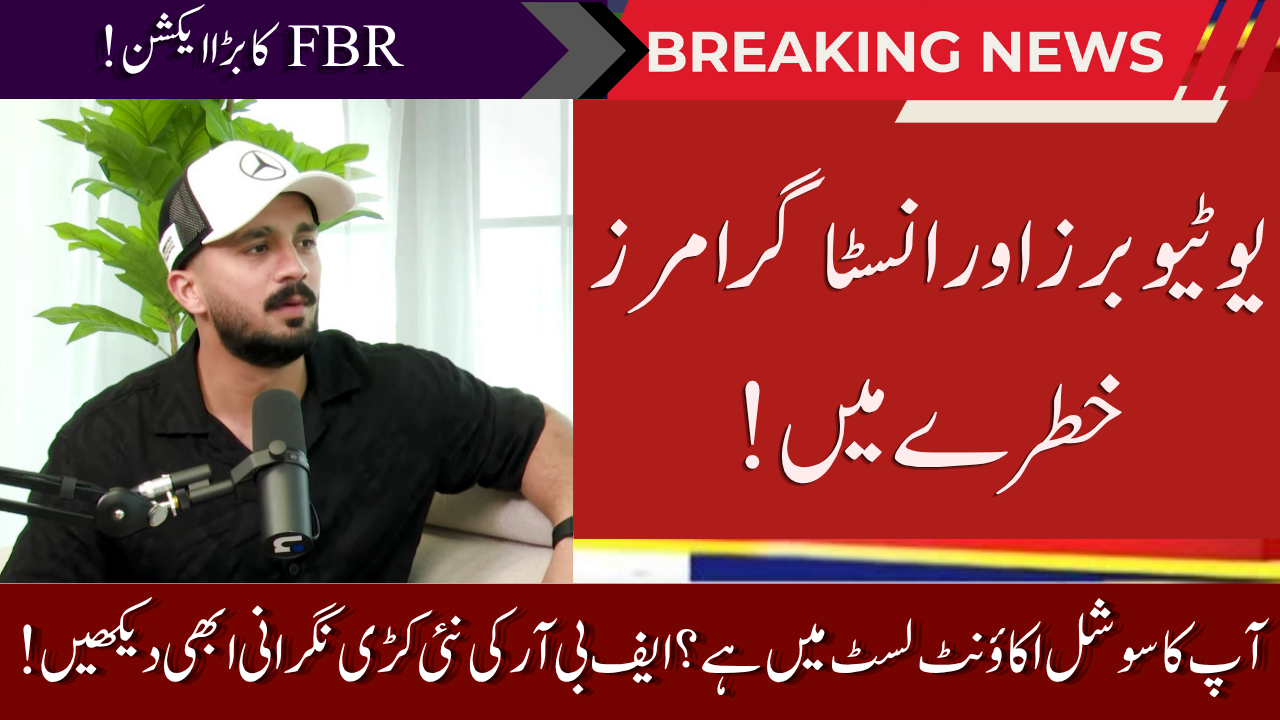
FBR Takes Action Against Social Media Influencers: 100,000 Accounts Being Reviewed
The FBR enforcement against social media influencers has created significant ripples throughout Pakistan’s online landscape. As the Federal Board of Revenue (FBR) escalates measures to combat tax evasion, more than 100,000 influencers and prominent personalities are currently under digital scrutiny for exhibiting luxurious lifestyles that don’t match their reported incomes.
This historic initiative signals the beginning of a new chapter in tax enforcement, indicating that the era of untaxed opulence is drawing to a close.
Significance of the FBR Enforcement Against Social Media Influencers
For an extended period, social media influencers in Pakistan have flaunted designer outfits, expensive cars, exotic vacations, and grand events—often without disclosing a corresponding income. The FBR enforcement against social media influencers seeks to address this growing dissonance between online appearances and tax obligations.
Insiders within the FBR reveal that the agency has accumulated a wealth of data from digital platforms, rendering attempts to delete old posts ineffective. Even as some influencers hurriedly attempt to erase “proof” of their lavish lifestyles, investigators remain well ahead in the game.

FBR’s Enhanced Monitoring and Data Gathering
The FBR’s Intelligence and Investigation Directorate spearheads this nationwide initiative. Cutting-edge monitoring technologies are being employed to observe influencers’ conspicuous spending on various platforms like Instagram, TikTok, YouTube, and Facebook.
Officials have disclosed that they are currently building three to four tax evasion cases each day, concentrating on individuals whose reported incomes appear suspiciously low relative to their visible affluence. The FBR enforcement against social media influencers stands as one of the most analytics-driven operations in the agency’s history.
Initial Cases in Major Cities
Internal reports indicate that four new tax evasion cases have already been lodged against influencers and high-profile social media personalities from Rawalpindi, Lahore, Bahawalpur, and Islamabad.

“In every instance, the reported income does not align with the observable spending levels,” verified an FBR source.
The operation has also reached a notable politician’s son from South Punjab, whose case is reportedly ready for court submission.
These preliminary cases are expected to establish strong legal precedents, signaling that online fame does not exempt one from tax liabilities.

Methods of Tracking Undeclared Wealth by the FBR
The FBR enforcement against social media influencers involves more than simply analyzing posts and images. The agency is collecting financial intelligence from a variety of sources to verify unreported assets and spending.
Information is being gathered from:
- Wedding venues to monitor event expenditures
- Fashion designers and boutiques to assess luxury acquisitions
- Beauty parlors and makeup professionals to evaluate usage of high-end services
- Travel companies for patterns in international trip spending
This comprehensive approach allows the FBR to match influencers’ spending behaviors with their official tax returns, leaving minimal room for evasion.

Concerns for Influencers
The FBR’s actions signify a larger shift in tax compliance enforcement. Influencers who once thought their online lifestyles were beyond legal reach are now subject to direct oversight.
Those displaying extravagant assets—luxury cars, brand partnerships, or lavish wedding celebrations—may soon face tax audits, severe fines, or even legal repercussions.
Experts predict this FBR enforcement against social media influencers will reshape Pakistan’s influencer economy, compelling creators to synchronize their tax declarations with their actual earnings.

Repercussions for Pakistan’s Digital Economy
While the crackdown might initially induce anxiety, it may ultimately enhance the credibility and transparency of Pakistan’s digital economy. Influencers who operate within legal frameworks, fulfill tax obligations, and maintain transparent financial practices will likely thrive in this new landscape.
By discouraging unreported income, the FBR aims to boost national tax revenues and build a more equitable system where everyone contributes appropriately.
The FBR enforcement against social media influencers is not merely about enforcement—it’s about establishing digital accountability and restoring public confidence in the system.
In Summary
The message from the Federal Board of Revenue is crystal clear: digital stardom does not exempt anyone from fiscal responsibility. The FBR enforcement against social media influencers serves as a wake-up call for all content creators to scrutinize their finances, report their earnings, and ensure compliance.
As Pakistan’s influencer market continues to expand, so does the expectation for fiscal transparency. The FBR’s latest initiative marks a pivotal moment for digital accountability—one that has the potential to permanently alter how social media influencers function in the country.