
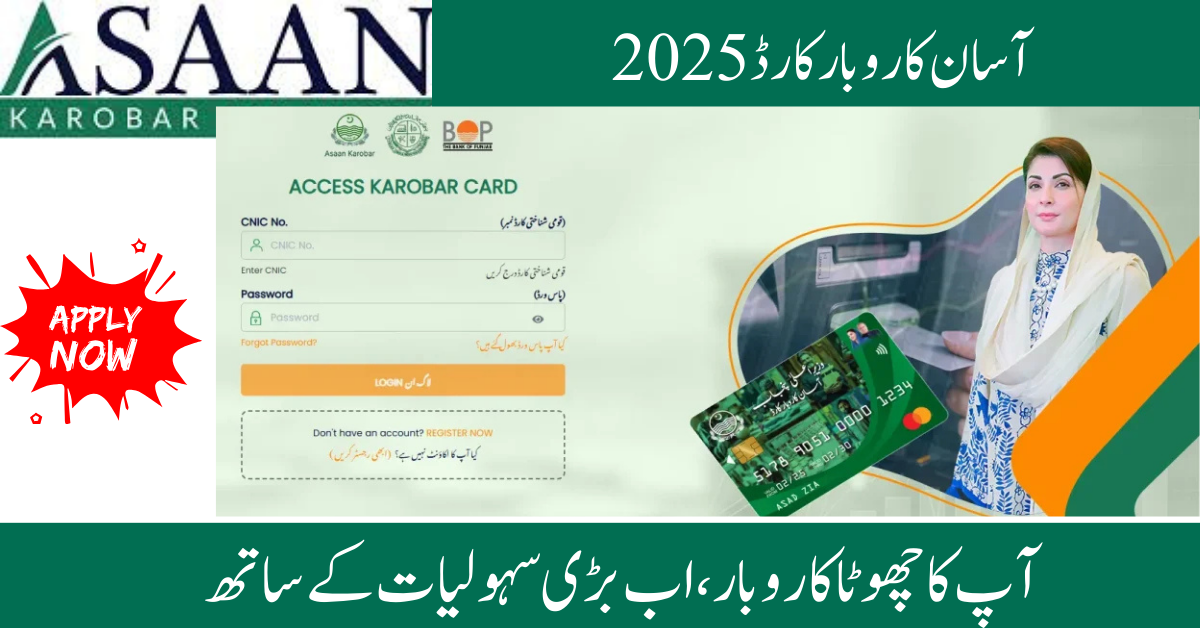
Easy Business Card 2025
Operating a small shop or service in Pakistan can feel like a high-stakes balancing act—money coming in, money going out, and always the risk of running out just before customers arrive. That’s where the Asan Karobar Card 2025 has been quietly changing lives.
In 2025, banks enhanced the program with more user-friendly features, aimed at assisting traders, freelancers, and micro-entrepreneurs in managing their finances confidently. If you’ve ever struggled with inventory payments or worried about covering monthly expenses, this card could be your financial lifeline.
Quick Overview of the Asan Karobar Card 2025
Here’s a quick summary of what you should know before diving into the details.
| Feature | Information (2025 Update) |
|---|---|
| Official Name | Asan Karobar Card |
| Product Type | Debit/prepaid or micro-credit facility |
| Target Users | Small traders, shopkeepers, freelancers, MSMEs |
| Limit Range | PKR 50,000 – PKR 500,000 (initial, subject to review) |
| Key Benefits | Easy onboarding, QR integration, utility payments |
| Application Time | 3–7 business days via e-KYC or branch |
| Support | Available across major Pakistani banks |
Other Site Of Punjab Scheme: Schemes of Punjab
What Makes the Asan Karobar Card Unique?
Unlike traditional SME loans that overwhelm you with paperwork, the O bypasses the monotony. It’s designed for the hustle of everyday entrepreneurs who can’t afford to wait weeks for approvals.
- Faster Approvals: Digital NADRA verification accelerates the process.
- Flexible Usage: Use it to pay bills, purchase stock, or withdraw cash when needed.
- Boosts Credit History: Responsible use builds a financial profile.
It’s like having a banking shortcut in your wallet—minus the red tape.
Official Website: Asan Karobar Card
Fresh Updates for 2025
The year 2025 introduced thoughtful enhancements to keep up with Pakistan’s shifting digital economy.
1. Digital First Approach
Banks have expanded e-KYC (electronic Know Your Customer), enabling many applicants to complete the process through apps without visiting a branch.
2. Higher Initial Limits
In response to inflation, initial limits have been increased. Some banks now provide a minimum of PKR 150,000, a significant improvement from previous years.
3. Raast Integration
Merchants using Raast QR codes can now link payments directly to their asan karobar card – a double benefit for Pakistani traders and small enterprises, facilitating smoother accounting and more reliable cash flow.
4. Utility & Tax Payment Features
Enhanced options for paying government fees, electricity bills, and even mobile top-ups. Some issuers have sweetened the deal with cashback offers—a minor but appreciated perk.
5. Spend Analytics
Monthly statements now feature simplified charts and automatic expense categorization, helping you track spending trends like a mini accountant.
Eligibility and Requirements
To apply in 2025, you’ll generally need:
- Valid CNIC (with biometric verification)
- Proof of business, such as shop rent slips, utility bills, or invoices
- A personal mobile SIM registered under your CNIC
- Two references (suppliers or clients) in some cases
Age requirement: 18 years or older.
Pro tip: Keep your supplier invoices handy—banks appreciate clean paper trails.
Costs and Charges
While fees vary among banks, here’s an approximate range for 2025:
| Fee/Rate | Typical Range |
|---|---|
| Annual Fee | PKR 0 – 2,000 (often waived the first year) |
| Cash Withdrawal (credit line) | 2–3% + FED |
| Mark-up Rate | 25–30% annually (on revolving credit) |
| Late Payment Fee | PKR 500 – 1,500 |
| Pos/Utility Payments | Free with most offerings |
Real-Life Example
Consider Rashid, a small garment shop owner in Faisalabad. He leveraged his ‘asan karobar card’ to buy fabric in bulk before Eid, when demand surged. Payments from Raast QR transactions went directly into his bank account, and after three months of responsible usage, his credit limit increased automatically by PKR 100,000.
For him, the card represented more than just money—it symbolized peace of mind.
Program Background
The Asan Karobar Card 2025 is part of Pakistan’s broader National Financial Inclusion Strategy, created to empower micro-entrepreneurs who have historically been marginalized from formal credit.
By simplifying requirements, it enables thousands of small shopkeepers to:
- Build financial history
- Access future SME loans
- Transition from precarious informal lenders to reliable banking
This is how grassroots economic strength is built—from the neighborhood shop up.
Net Worth or Economic Impact
Since it’s a financial program, rather than an individual, the “net worth” of an Asan Karobar card can only be evaluated in terms of impact. Bank reports for 2025 indicate:
- Over 250,000 cards issued nationwide by mid-2025.
- Average ticket size: PKR 120,000.
- Over PKR 20 billion in transaction volume processed through these cards last year.
These figures don’t just represent numbers—they signify thousands of families gaining stability and dignity in their businesses.
Final Thoughts
The Asan Karobar Card 2025 remains an invaluable asset for Pakistan’s resilient small business community. It’s quicker, smarter, and—most importantly—designed for individuals who lack the luxury of time for redundant paperwork.
For traders juggling daily challenges, this card is more than just a piece of plastic. It’s a pathway to dignity, opportunity, and growth. And truly, that’s the kind of “shortcut” every dedicated entrepreneur deserves.